Executive Audit Summary
Every carrier network operates through high-speed automation belts, optical dimensioners, and predetermined sorting nodes. Once a shipment crosses the intake threshold, human hands rarely adjust packaging errors. Aligning your dispatch routines with automated conveyor mechanics prevents unreadable scans, manual exception delays, and transit re-routing.
The Initial Induction and Optical Scan Stage
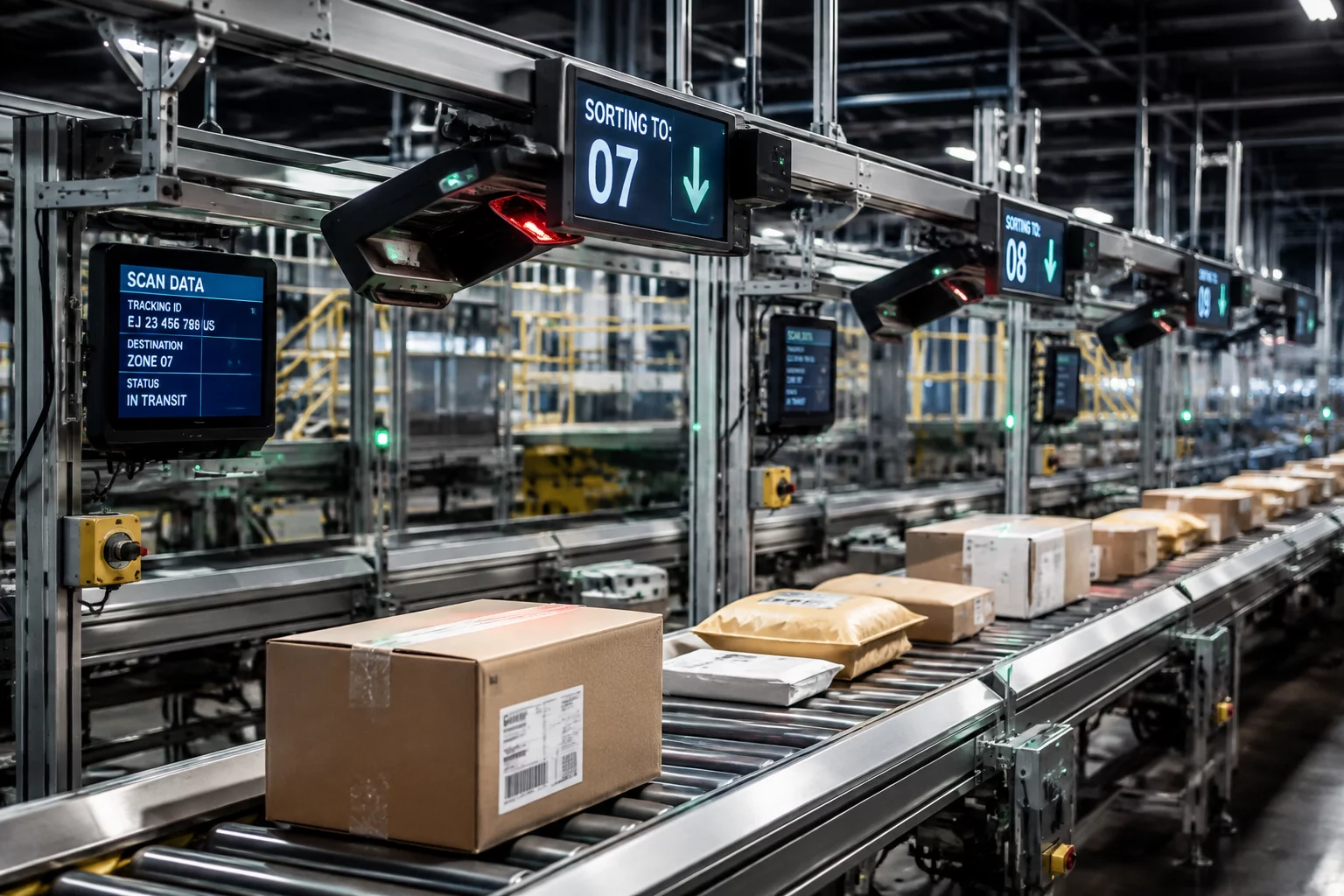
Immediately after physical handoff at the loading dock or postal acceptance counter, packages enter primary singulation belts. Multi-angle laser scanners and high-resolution cameras capture barcode telemetry at speeds exceeding eight feet per second. When a shipping label wrinkles over a box corner or sits underneath glossy reflective tape, automated scanners fail to register the code instantly.
Failed initial scans push items into manual exception lanes. There, staff must re-scan barcodes manually with handheld terminals or reprint damaged labels. This bottleneck frequently causes shipments to miss scheduled outbound linehaul departures, adding twenty-four to forty-eight hours to overall transit times.
Mandatory Verification Criteria
Ensure barcode labels occupy a flat surface with at least 1.5 inches of clearance from edges, seams, or packing tape. Avoid folding barcodes around edges to ensure uninterrupted 360-degree scanner reads.
Secondary Sorting and Regional Linehaul Logistics
Once inducted, automated cross-belt sorters categorize boxes into designated gaylords, roll cages, or freight containers corresponding to regional sectional center facilities (SCFs). During linehaul transit, containers endure significant kinetic vibration, stacking pressure, and rapid temperature shifts. Structural box rigidity and complete internal void fill directly determine whether boxes withstand stacked pallet weight or collapse during transport.
Pre-Dispatch Inspection Checklist
-
2D Routing Barcode printed with crisp resolution above 300 DPIVERIFIED
-
Outer box seams sealed with 2-inch minimum water-activated or heavy tapeVERIFIED
-
Weight and cubic dimensions matched to electronic manifest recordVERIFIED
Destination Delivery Units and Final-Mile Route Sequence
At destination delivery units, sorting machines organize mail pieces into delivery point sequence (DPS) corresponding directly to the carrier route order. Missing suite numbers, ambiguous building entrances, or outdated postal codes force carriers to manually look up recipient data on mobile delivery devices, increasing the probability of non-delivery returns.